A patient presents a Health Savings Account (HSA) or Flexible Spending Account (FSA) card to pay for treatment. Your team processes it like any other card—and the transaction is declined.
The patient insists there is money in the account. The service appears medically necessary. Your staff tries the card again, but the answer is the same: declined.
HSA and FSA card declines can be confusing because several different systems are involved. A decline does not necessarily mean the treatment is ineligible, the account is empty or your payment terminal is malfunctioning. The problem could involve the patient’s available balance, the date or type of service, the card itself, the account administrator or even the way your practice is classified within the payment network.
With nearly $174 billion held across more than 41 million HSA accounts at the end of 2025, these cards represent a substantial and growing portion of healthcare spending. Practices need a consistent process for handling them without embarrassing the patient, delaying care or creating additional work for the front desk. (Devenir Research)
HSA and FSA Cards Are Not Ordinary Debit Cards
HSA and FSA cards may look and function like traditional debit cards, but they are connected to tax-advantaged healthcare accounts and subject to additional rules.
An HSA is an individually owned account. The money remains in the account until it is spent, and the account generally stays with its owner when that person changes jobs. HSA distributions can be tax-free when used for qualified medical expenses incurred after the HSA was established.
An FSA is an employer-established benefit. Employees elect an annual amount, and the full elected amount is generally available during the coverage period—even before the employee has contributed the entire amount through payroll deductions. Unlike an HSA, an FSA is generally subject to “use-it-or-lose-it” rules, although an employer’s plan may offer a limited carryover or grace period. (IRS Publication 969)
Both types of accounts are intended for qualified medical expenses, but the card transaction itself must still pass the account administrator’s controls.
The Most Common Reasons an HSA or FSA Card Is Declined
1. The Expense May Not Be Eligible
The first question is whether the charge is for a qualified medical expense.
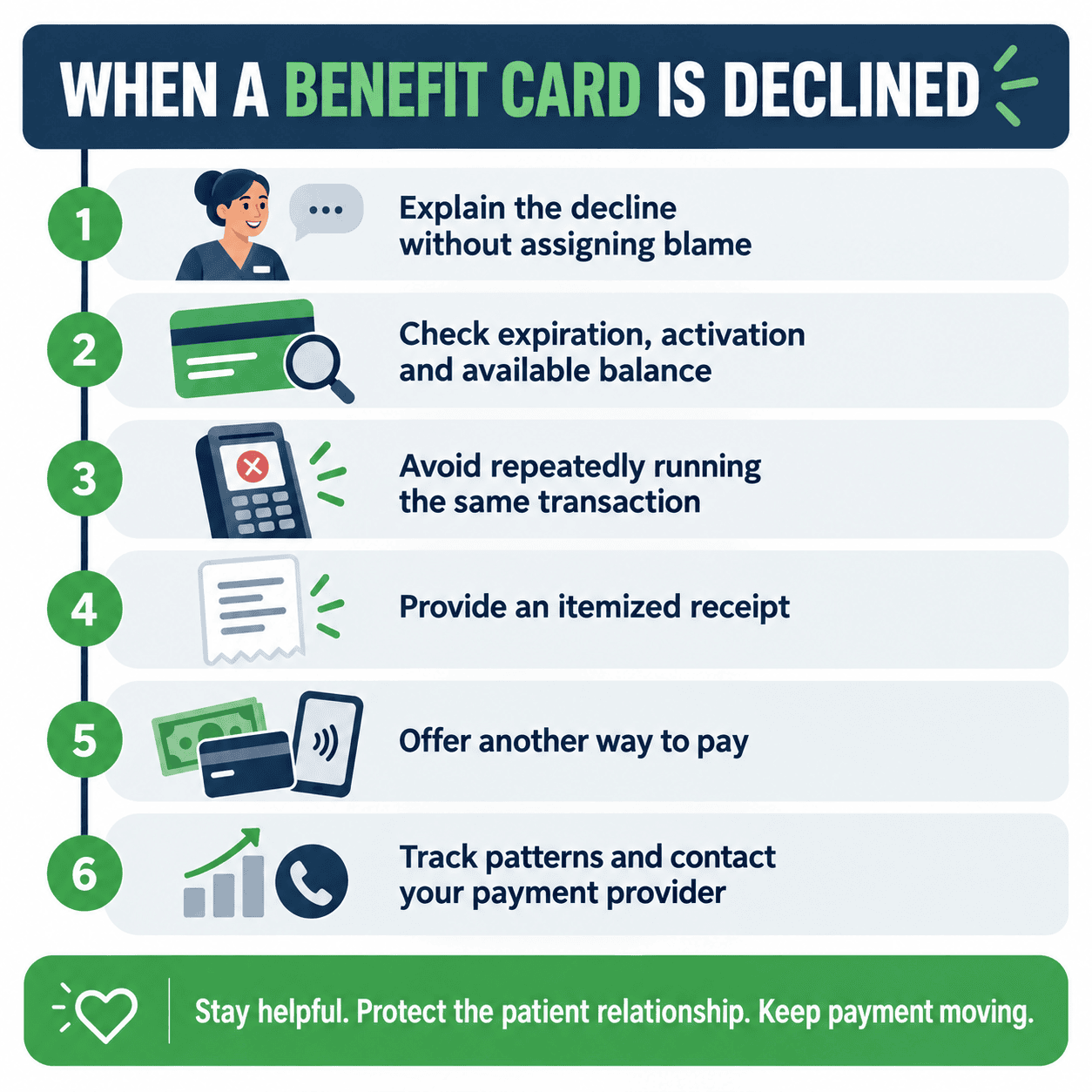
Many common medical and dental services qualify, including examinations, diagnostic procedures, physical therapy, dental cleanings, X-rays, fillings, braces, extractions and dentures. However, a service performed by a healthcare provider is not automatically eligible simply because it was purchased at a medical or dental office.
For example, the IRS generally excludes procedures performed solely to improve appearance when they do not meaningfully promote proper bodily function or prevent or treat an illness. Teeth whitening, most purely cosmetic procedures, health-club dues and many general-wellness purchases are common examples. Cosmetic procedures may qualify when they address a deformity caused by a congenital condition, trauma or disfiguring disease. (IRS Publication 502)
Eligibility can also depend on:
- Who received the care
- When the expense was incurred
- Whether insurance or another benefit already paid it
- Whether the patient’s particular FSA plan covers the expense
- Whether supporting medical documentation is required
Your practice should accurately describe the service and provide an itemized receipt, but your staff should not make a definitive tax determination for the patient. The patient or account administrator is ultimately responsible for confirming eligibility.
An Important Note for Veterinary Practices
Ordinary veterinary care for a household pet generally is not an HSA- or FSA-qualified medical expense. The IRS provides a limited exception for certain costs associated with a guide dog or other service animal used by a person with a qualifying disability. (IRS guidance on veterinary fees)
If a veterinary client attempts to use an HSA or FSA card for routine pet care, a decline may be the expected result. Veterinary teams should offer another payment method without suggesting that ordinary pet treatment is eligible for reimbursement.
2. The HSA Does Not Have Enough Available Cash
An HSA card normally draws from the cash available in the account. A patient might know the total value of the HSA but overlook that part of the balance is invested or otherwise unavailable for immediate card purchases.
The account may also contain less money than the patient expects because of:
- Previous medical purchases
- Pending transactions
- Recent contributions that have not posted
- Account or investment-transfer processing times
- Administrative fees
- A transaction amount that exceeds a card limit
If the available amount is less than the bill, the practice may be able to split the payment. For example, the patient could pay $300 from the HSA and place the remaining $150 on another card. The patient should first verify the amount available through the account administrator’s website, app or customer-service number.
An HSA differs from an FSA in this respect. An HSA can generally disburse only money actually available in the account. A healthcare FSA generally makes the participant’s entire annual election available during the coverage period, although prior claims, plan restrictions, account suspension or administrative issues can reduce or block what remains available.
3. The Card Is Expired, Inactive or Not Yet Activated
Sometimes the simplest explanation is the correct one.
An HSA or FSA card can be declined because:
- The card has expired
- A replacement card was issued
- The patient has not activated it
- The account was temporarily locked
- The patient entered the wrong PIN
- The card was reported lost or compromised
- The patient changed employers or benefit administrators
- The plan year ended and the card was replaced
- The administrator detected unusual activity
Ask the patient to check the expiration date and contact the number on the back of the card. Practice employees should never call while pretending to be the cardholder or request the patient’s account password.
4. The Expense Falls Outside the Coverage Period
Timing matters, especially for FSAs.
FSA funds generally reimburse eligible expenses incurred during the plan’s coverage period. An account may have money showing, but the service date may fall outside that period. A plan may offer a grace period or carryover, but those features are determined by the employer’s plan and are not universal.
HSA rules are different. HSA funds can generally be used for qualified medical expenses incurred after the HSA was established. The patient does not have to withdraw the money in the same year the expense occurred, but should keep records showing that the expense was eligible and was not previously reimbursed. The IRS specifically instructs HSA owners to retain supporting records with their tax documents. (IRS HSA distribution and recordkeeping rules)
A payment card may still decline even if the expense could eventually be reimbursed through a manual claim.
5. Your Practice May Have the Wrong Merchant Classification
Every merchant account is assigned a merchant category code, or MCC, that identifies the general type of business accepting the payment. HSA and FSA card systems may use this classification to determine whether a card can be accepted at that business.
If a medical, dental, vision, physical therapy or other healthcare practice is assigned an incorrect or overly general business classification, HSA and FSA transactions may be rejected—even when the underlying service appears eligible.
IRS guidance recognizes the role of healthcare-related merchant category codes in restricting medical-benefit card use. The rules were designed to prevent cards from being used freely at merchants that sell large amounts of nonmedical merchandise. Certain non-healthcare merchants must use an approved inventory system or meet other requirements before benefit cards can be accepted. (IRS Notice 2007-2)
Repeated declines from multiple patients may indicate a merchant-account configuration problem rather than a problem with each patient’s card.
Your practice should ask its payment processor to verify:
- The MCC assigned to the merchant account
- Whether each practice location has the correct classification
- Whether online, terminal and virtual-terminal transactions use the same merchant profile
- Whether the account is enabled to accept HSA and FSA cards
- Whether a recent equipment or processor change affected the configuration
Do not simply change the classification to obtain approvals. The code must accurately represent the practice and its primary business activity.
6. The Administrator Needs More Documentation
FSA administrators must substantiate expenses under applicable rules. Some transactions can be verified automatically, while others require a receipt, explanation of benefits or other documentation.
A card may be suspended if the participant failed to provide documentation for an earlier transaction. In that situation, today’s perfectly valid purchase may decline because of an unresolved claim from weeks or months ago.
An itemized receipt should clearly show:
- Practice name
- Patient name, when appropriate
- Date of service
- Type of service or product
- Amount charged
- Amount paid
- Any insurance adjustment or remaining patient responsibility
A generic receipt showing only a total may not give the administrator enough information to approve reimbursement.
7. The Decline May Be Unrelated to HSA or FSA Eligibility
Benefit cards can also experience many of the same technical problems as ordinary payment cards, including:
- Incorrect card information
- A damaged chip or magnetic stripe
- Terminal communication problems
- Temporary issuer outages
- Fraud-prevention controls
- Daily transaction limits
- Billing-address mismatches during online payments
- Duplicate-transaction protection after repeated attempts
If one card is declining, the patient should contact the administrator. If many HSA and FSA cards are declining, the practice should contact its payment provider.
What Your Staff Should Do When a Card Is Declined
A consistent response prevents confusion and keeps the conversation professional.
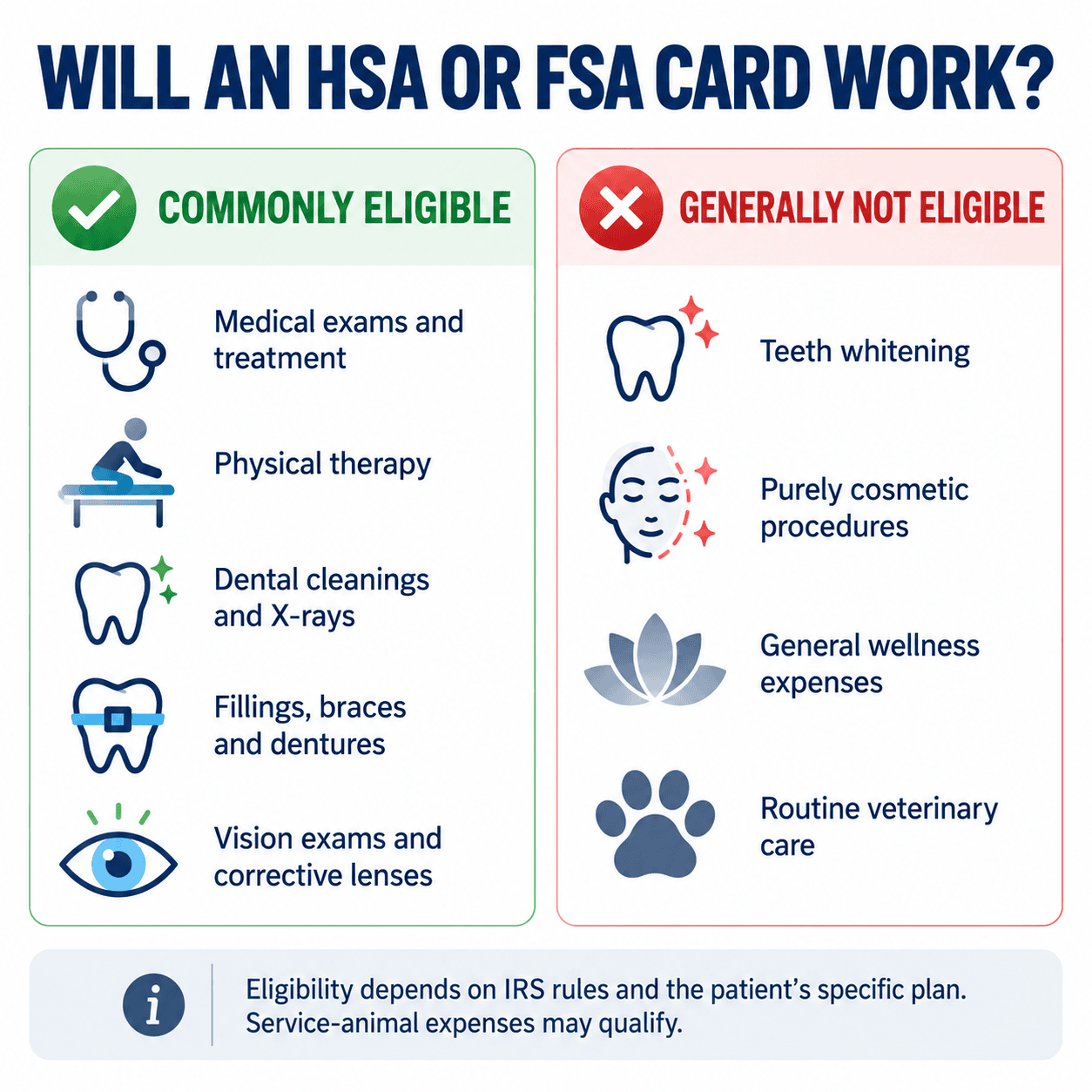
Step 1: Explain the Decline Without Assigning Blame
A helpful response might be:
“Sometimes these cards decline because of the available balance, the benefit administrator’s rules or the way the transaction is being recognized. Let’s look at a few other ways we can complete the payment.”
Avoid announcing that the patient has insufficient funds. Most decline messages do not provide enough information to support that conclusion.
Step 2: Confirm the Basic Information
Ask the patient to check:
- The card’s expiration date
- Whether the card has been activated
- The available account balance
- Whether the administrator has requested documentation
- Whether the card is temporarily locked
The patient can usually check these details through the administrator’s app, website or customer-service number.
Step 3: Do Not Repeatedly Run the Same Transaction
Trying the same amount several times rarely resolves the underlying issue. Repeated attempts can create duplicate pending authorizations or trigger additional fraud controls.
If the patient confirms that only part of the balance is available, process a split payment if your system supports it.
Step 4: Provide an Itemized Receipt
If the service is eligible but the card cannot be used directly, the patient may be able to pay with another method and submit a claim for reimbursement.
Make that process easier by providing a detailed receipt at the time of payment. For medical and dental services, include enough information for the administrator to understand what was provided without disclosing unnecessary clinical details.
Step 5: Offer Another Way to Pay
Depending on the practice and the balance, alternatives may include:
- A personal debit or credit card
- ACH or bank-account payment
- A secure payment link
- A split payment using the available HSA balance plus another method
- An approved payment plan
- Patient financing
- Payment by a spouse or authorized family member
- Paying personally and requesting reimbursement from the HSA or FSA administrator
Alternative payment options help the practice collect promptly while allowing the patient to resolve the benefit-card issue separately.
Step 6: Look for a Pattern
One isolated decline usually belongs with the patient or administrator. Several declines across different HSA and FSA issuers deserve investigation.
Track:
- The date and location
- How the payment was attempted
- Whether the transaction was in person, online or by phone
- Whether other cards worked on the same terminal
- The processor’s decline response
- Whether the problem began after an equipment or account change
This information can help your payment provider determine whether the practice’s merchant category, terminal setup or payment configuration is contributing to the problem.
Create a Better HSA and FSA Payment Experience
HSA and FSA cards make it easier for many patients to use tax-advantaged funds for qualified care. Their popularity also makes it important for medical and dental practices to understand why these transactions sometimes fail.
Your staff does not need to become an expert in tax law. It does need a simple process: explain the decline respectfully, verify basic card information, provide an itemized receipt, offer another payment option and escalate recurring problems to the payment provider.
PayLow Pro helps medical, dental and patient-centered practices modernize how they accept payments. With flexible in-office and online payment technology, detailed reporting and multiple ways for patients to pay, practices can reduce payment friction while protecting cash flow.
If your practice is experiencing repeated HSA or FSA card declines—or your current payment system makes it difficult to offer convenient alternatives—contact PayLow Pro to discuss a payment setup designed around your workflow.
This article is provided for general informational purposes and is not tax, legal or benefits advice. Eligibility and reimbursement decisions are made under applicable law and the terms of the patient’s specific plan. Patients should consult their account administrator or tax adviser regarding individual expenses.