Healthcare organizations have invested billions of dollars in digital transformation over the past decade. From Electronic Health Records (EHRs) and practice management software to patient communication tools and telehealth platforms, technology has become essential to modern healthcare delivery.
Yet many medical, dental,veterinary, and specialty practices discover that implementing new technology is only part of the challenge.
The real hurdle is making all of these systems work together efficiently.
According to industry research, physicians can spend nearly half of their workday interacting with EHR systems and administrative tasks rather than direct patient care. When software platforms fail to communicate effectively, staff productivity declines, payment collection slows, and the patient experience suffers.
The good news is that healthcare practices can overcome many of these challenges by implementing payment solutions that integrate directly into their existing workflows.
The Growing Technology Burden on Healthcare Practices
Healthcare providers face increasing pressure from multiple directions:
- Rising labor costs
- Increased compliance requirements
- Higher patient financial responsibility
- More complex billing workflows
- Growing cybersecurity concerns
- Increasing demand for digital payment options
At the same time, patients now expect the same convenient payment experience they receive from retailers, restaurants, and online businesses.
When systems operate independently from one another, practices often find themselves dealing with duplicate data entry, manual reconciliation, payment posting delays, and unnecessary administrative work.
Common Technology Challenges Healthcare Practices Face
1. Multiple Systems That Don't Communicate
Many healthcare offices use separate platforms for scheduling, billing, patient records, payments, financing, and communications.
When these systems aren't integrated, staff members must manually transfer information between platforms, increasing the likelihood of errors and creating workflow bottlenecks.
Even small inefficiencies can add up quickly when multiplied across hundreds of patient visits each month.
2. Security and Compliance Risks
Healthcare organizations handle some of the most sensitive information in any industry.
Practices must comply with HIPAA requirements while also maintaining PCI compliance for payment processing.
Using disconnected systems can increase security risks, create data silos, and make compliance management more difficult.
Integrated payment technology helps reduce these risks by centralizing information and minimizing unnecessary handling of sensitive data.
3. Rising Administrative Costs
Administrative expenses continue to consume a significant portion of healthcare operating budgets.
Staff members often spend hours each week:
- Posting payments
- Managing invoices
- Following up on balances
- Reconciling transactions
- Updating patient accounts
Automation can dramatically reduce these tasks, allowing staff to focus on patient care rather than paperwork.
4. Staff Training and Adoption Issues
Every new technology implementation requires employee training.
Complicated systems often create resistance among team members who are already managing busy schedules and patient demands.
The best technology solutions are designed to be intuitive, reducing learning curves and accelerating adoption.
5. Patient Payment Friction
Healthcare consumerism continues to grow.
Patients increasingly expect:
- Online payments
- Mobile payment options
- Text-to-pay capabilities
- Stored payment methods
- Flexible financing solutions
Practices that fail to offer modern payment experiences may experience slower collections and lower patient satisfaction.
6. Revenue Cycle Inefficiencies
Delayed payments, manual billing processes, and fragmented technology systems can negatively impact cash flow.
Healthcare organizations need solutions that help accelerate collections while maintaining a positive patient experience.
Why Integrated Payments Matter More Than Ever
The healthcare payments landscape has changed dramatically.
A growing percentage of healthcare revenue now comes directly from patients through deductibles, copays, coinsurance, and out-of-pocket expenses.
As patient responsibility increases, practices need faster and more convenient ways to collect payments.
Integrated payment technology allows healthcare organizations to:
- Accept payments directly within existing workflows
- Reduce manual data entry
- Improve collection rates
- Simplify reconciliation
- Enhance patient convenience
- Maintain compliance requirements
- Improve operational efficiency
When payment processing is connected to practice management and EHR systems, staff can spend less time chasing payments and more time serving patients.
How PayLow Pro Helps Healthcare Practices Improve Efficiency
PayLow Pro is designed to help healthcare organizations streamline payment acceptance while reducing operational complexity.
Our solutions integrate with many leading healthcare software platforms, helping practices create a more connected workflow from appointment scheduling through final payment collection.
Sources:
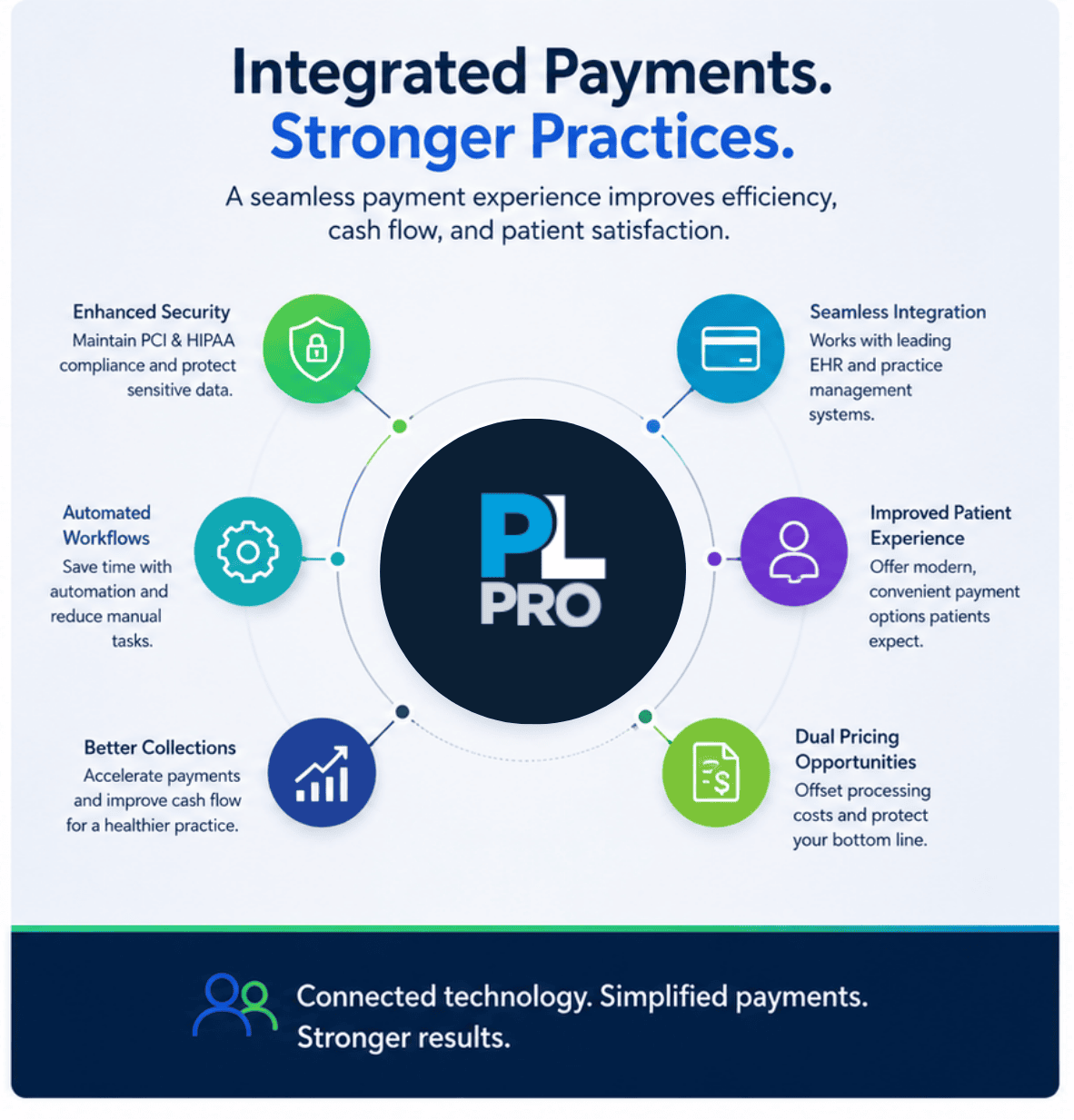
Healthcare providers can benefit from:
Integrated Payment Acceptance
Accept in-person, online, recurring, and mobile payments through a single platform that fits naturally into existing office operations.
Enhanced Security
Maintain PCI compliance while helping protect sensitive payment information through secure payment technologies.
Automated Payment Workflows
Reduce manual administrative tasks through automation that simplifies payment collection and reconciliation.
Improved Patient Experience
Offer modern payment options that today's patients expect, including digital payment methods and convenient self-service tools.
Dual Pricing Opportunities
Many healthcare providers are also exploring compliant Dual Pricing programs through PayLow Pro to offset rising payment processing expenses and preserve revenue.
Scalable Technology
Whether you operate a single practice or a multi-location healthcare organization, PayLow Pro solutions can grow alongside your business.
Technology Should Make Healthcare Easier
Technology investments should simplify operations—not create additional work.
Healthcare organizations that connect their payment systems with their existing software infrastructure often experience faster collections, improved efficiency, reduced administrative burdens, and a better overall patient experience.
As healthcare continues to evolve, practices that embrace integrated payment technology will be better positioned to improve profitability while maintaining a patient-first approach.
Modernize Your Healthcare Payment Experience
PayLow Pro helps medical practices, dental offices, veterinary clinics, specialty providers, and healthcare organizations streamline payment acceptance while improving operational efficiency.
Whether you're looking to simplify collections, enhance patient convenience, reduce administrative workload, or explore Dual Pricing strategies, our team can help identify the right solution for your practice.
Contact PayLow Pro today to learn how integrated payment technology can help your healthcare organization operate more efficiently while improving both staff and patient satisfaction.
Sources
- Rectangle Health. EHR Integration Challenges: Addressing Common Pain Points With EHR Integration for Healthcare Practices. https://www.rectanglehealth.com/resources/blog/ehr-integration-challenges-addressing-common-pain-points-with-ehr-integration-for-healthcare-practices
- U.S. Department of Health & Human Services, Office for Civil Rights. Health Information Privacy (HIPAA). https://www.hhs.gov/hipaa/index.html
- Upadhyay DK, Hu Z. The State of Interoperability Among U.S. Non-Federal Acute Care Hospitals in 2021. Journal of General Internal Medicine. https://link.springer.com/article/10.1007/s11606-022-07964-9
- National Academy of Medicine. Taking Action Against Clinician Burnout: A Systems Approach to Professional Well-Being. https://nam.edu/initiatives/clinician-resilience-and-well-being/
- CAQH. 2024 CAQH Index Report. https://www.caqh.org/solutions/caqh-index