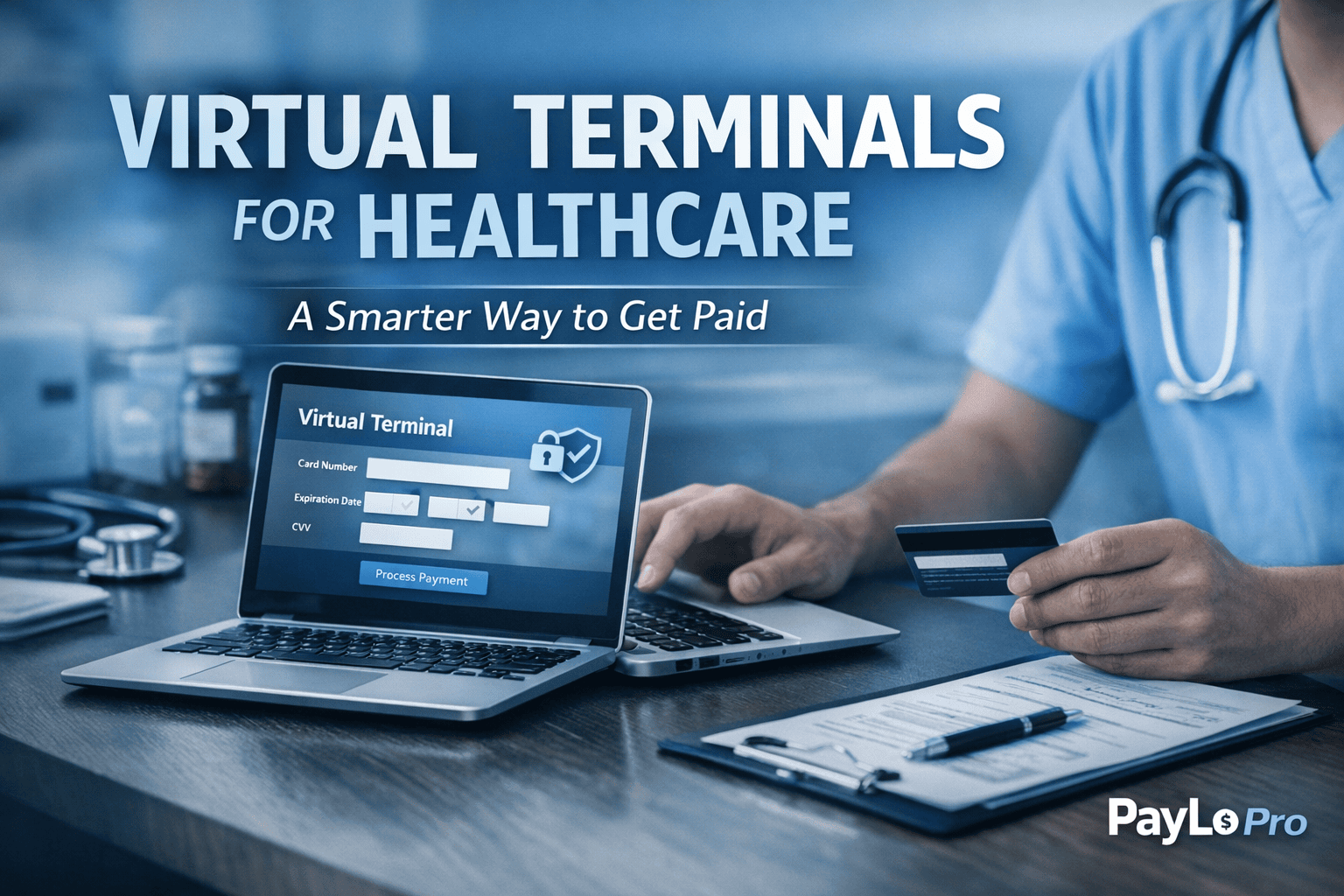
Every medical practice—whether it’s a general medical office, dental clinic, specialty provider, or veterinary practice—faces the same operational challenge: getting paid quickly, securely, and without friction. Patients expect flexibility in how they pay, while staff need efficient tools that don’t add complexity to their day. At the same time, administrators are under constant pressure to control costs and improve cash flow.
A virtual terminal is one of the simplest ways to address all three.
What Is a Virtual Terminal?
A
virtual terminal is a secure, web-based payment tool that allows your team to manually enter and process payments from a computer or tablet, without needing a physical card reader. This makes it especially useful in medical environments where payments don’t always happen at a front desk. Whether a patient is calling in to pay a balance, responding to a statement, or putting down a deposit for an upcoming procedure, your staff can process the payment instantly from anywhere.
How It Works in Your Practice
Unlike retail environments, medical payments are often delayed or fragmented. Insurance claims take time to process, leaving patients with balances that need to be collected later. Offices frequently
send invoices after visits, manage recurring treatment plans, or collect deposits ahead of time for higher-cost procedures. Without the right tools, this can turn into a time-consuming, manual process that slows down revenue and frustrates both staff and patients. A virtual terminal simplifies this by centralizing payment collection into one easy-to-use system.
From a workflow standpoint, the process is straightforward. A staff member logs into a secure dashboard, enters the patient’s payment information, and submits the transaction. Within seconds, the payment is processed, a receipt can be issued, and the transaction is logged for reporting and reconciliation. Behind the scenes, the system uses secure payment gateways, encryption, and verification tools like AVS and CVV to protect sensitive data and reduce fraud risk.
In a healthcare setting, this flexibility opens the door to a number of practical use cases. Offices can collect appointment deposits at the time of scheduling, process payments over the phone without requiring a patient to come in, and quickly capture balances once insurance has finalized. Recurring billing can also be set up for ongoing care plans, memberships, or treatment programs, reducing the need for repeated follow-up. Even after-hours or remote payments become possible without relying on in-office hardware.
Security, of course, is critical in any healthcare environment. Virtual terminals are built with PCI-compliant processing standards, encrypted data transmission, and tokenization to ensure that sensitive cardholder information is protected at every step. This not only helps safeguard patient data, but also provides a clear audit trail for transactions, supporting both compliance and internal accountability.
Where PayLow Pro Changes the Equation
Where PayLow Pro takes this a step further is by turning payment acceptance into a cost-saving opportunity. By combining a virtual terminal with PayLow Pro’s Dual Pricing technology, practices can significantly reduce—or even eliminate—the cost of accepting credit cards. Patients are presented with a transparent card and cash price, giving them the freedom to choose how they pay, while the practice avoids absorbing unnecessary processing fees. At the same time, all payment channels—whether in-office, online, or over the phone—are unified into a single, easy-to-manage system.
What to Look for in a Medical Payment Solution
When evaluating a virtual terminal for a medical practice, it’s important to look beyond basic functionality. Ease of use for front desk and billing teams is essential, as is the ability to support invoicing, recurring billing, and secure card-on-file storage. Integration with existing workflows, clear reporting, and flexible payment options—including ACH or eCheck—can also make a meaningful difference in day-to-day operations. Just as important is pricing transparency, ensuring there are no surprises as transaction volume grows.
For many practices, the question isn’t whether they need a virtual terminal—it’s whether they can afford to operate without one. If your office regularly accepts payments over the phone, sends patient statements, manages ongoing care plans, or spends time chasing down balances, a virtual terminal becomes less of a convenience and more of a necessity.
Medical payments are evolving quickly. Patients expect the same convenience they experience in other parts of their lives, and practices need tools that keep up without adding complexity. A virtual terminal, especially when paired with PayLow Pro, provides a practical way to get paid faster, reduce administrative burden, improve the patient experience, and take control of processing costs—all without changing how your practice delivers care.