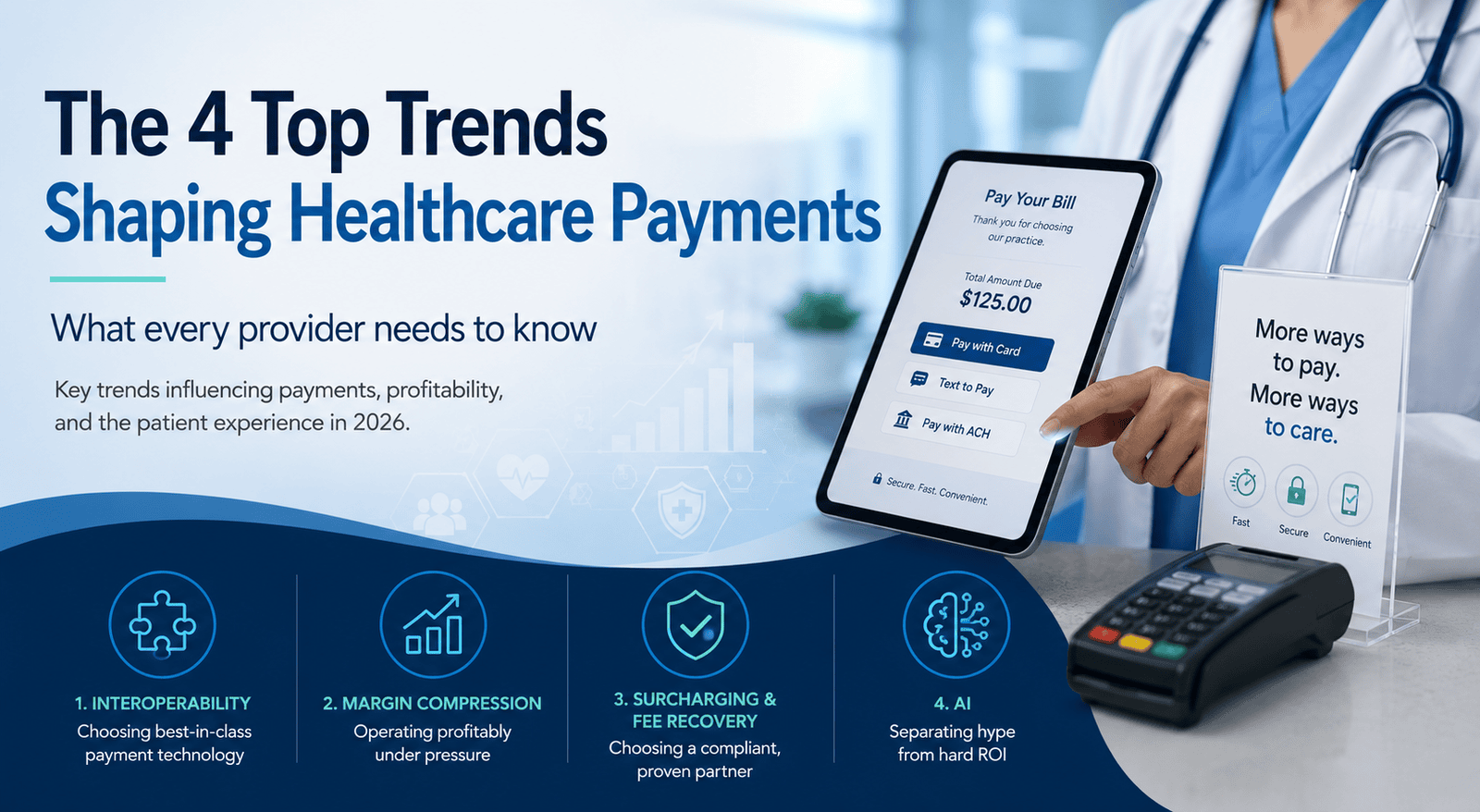
What Medical and Dental Practices Need to Know
The healthcare payments landscape is evolving rapidly. Rising operating costs, tighter margins, increasing patient expectations, and new technology are forcing practices to rethink how they manage payments and profitability.
For medical offices, dental groups, and healthcare organizations, the challenge is no longer just accepting payments — it’s creating a payment strategy that improves collections, reduces overhead, simplifies operations, and protects the patient experience.
At Paylow Pro, we work with healthcare providers every day who are navigating these exact challenges. Here are four of the biggest trends shaping healthcare payments in 2026 — and what practices should be thinking about now.
1. Integrated Payments vs. “One-Size-Fits-All” Systems
Healthcare practices today rely on more technology than ever before. EMRs, practice management systems, patient engagement tools, scheduling platforms, payment systems, texting solutions, and reporting software all need to work together efficiently.
Many EMR and PM providers are pushing bundled payment solutions built directly into their platforms. While convenience can sound attractive, bundled tools are not always the best fit for every practice.
In many cases, specialized payment platforms offer stronger functionality, more flexibility, better reporting, and more advanced automation features than embedded solutions.
Practices should evaluate whether their payment technology actually helps improve:
- Patient collections
- Accounts receivable timelines
- Payment flexibility
- Recurring billing workflows
- Online payment acceptance
- Text-to-pay capabilities
- Reporting visibility
- Patient satisfaction

PAYMENT STRATEGY TIP
The lowest-friction patient payment experience often leads to faster collections and stronger patient retention. Convenience matters more than ever.
Patients increasingly expect healthcare payments to feel like every other consumer transaction — simple, digital, mobile-friendly, and transparent.
2. Margin Compression Is Forcing Practices to Reevaluate Costs
Healthcare providers across nearly every specialty are facing margin pressure.
Labor costs remain elevated. Supply expenses continue to rise. Insurance reimbursements are tightening. Meanwhile, many practices are still absorbing significant credit card processing costs every month.
For multi-location healthcare groups and growing practices, those fees can quickly become substantial.
According to industry estimates, healthcare providers collectively spend billions annually on payment processing expenses. Many organizations are now taking a closer look at how payment technology impacts profitability.
That’s why practices are increasingly prioritizing:
- Consolidation of vendors
- Automation of payment collection
- Faster patient payments
- Reduced administrative overhead
- Lower processing expenses
- Better visibility into payment performance
PROFITABILITY TIP
Before evaluating any payment solution, define the KPIs that matter most to your practice — such as collection speed, patient balances, processing costs, or staff efficiency — and evaluate vendors based on measurable ROI.
The right payment strategy should improve both operational efficiency and financial performance.
3. Dual Pricing & Compliant Fee Recovery Models Continue to Grow
As processing costs continue rising, more healthcare providers are exploring compliant ways to offset payment expenses.
This has led to significant growth in programs like:
- Dual Pricing
- Cash Discounting
- Compliant Surcharging (where permitted)
However, healthcare is one of the most regulated industries when it comes to payment compliance.
Practices must carefully navigate rules involving:
- Debit card restrictions
- HSA/FSA card handling
- Medicare and Medicaid considerations
- State-level surcharge regulations
- Copay requirements
- Proper signage and receipt disclosures
DEFINITION: DUAL PRICING
Dual Pricing allows businesses to display both a cash price and a card price, giving patients the ability to choose their preferred payment method while helping offset rising processing expenses.
Unlike traditional surcharging, properly structured dual pricing programs are designed around transparency and compliance.
COMPLIANCE TIP
Not every payment company understands the complexities of healthcare compliance. Providers should work with experienced healthcare payment specialists who understand both operational workflows and regulatory requirements.
If a provider cannot clearly explain how their program handles debit cards, copays, or regulated healthcare transactions, that should raise concerns.
At PayLow Pro, compliant healthcare payment strategies are built specifically around the needs of medical, dental, veterinary, and specialty healthcare practices.
4. AI Is Becoming Useful — But ROI Still Matters
Artificial Intelligence is now being added to nearly every healthcare technology platform.
Some AI tools are delivering real operational improvements. Others are simply marketing buzzwords.
The key for healthcare providers is understanding where AI actually creates value.
Areas where AI may help include:
- Appointment reminders
- Scheduling optimization
- Payment reminders
- Collections outreach
- Patient communication automation
- Reporting and analytics
However, practices should be cautious about overcomplicated systems that create more administrative burden than measurable return.
AI EVALUATION TIP
When evaluating AI-driven tools, ask vendors one simple question:
“How will this improve operational efficiency or financial performance for our practice?”
If the ROI cannot be clearly measured, the technology may not justify the investment.
Healthcare remains deeply relationship-driven. Technology should support the patient-provider relationship — not replace it.
The Bottom Line
Healthcare organizations are under increasing pressure to improve efficiency, reduce costs, and modernize the patient payment experience.
The practices that succeed in 2026 will be the ones that:
- Simplify operations
- Improve payment workflows
- Reduce unnecessary costs
- Prioritize patient convenience
- Choose technology partners carefully
- Focus on measurable ROI
Modern healthcare payments are no longer just a back-office function — they are becoming a critical part of both profitability and patient satisfaction.
Whether your practice is exploring integrated payments, recurring billing, compliant Dual Pricing, text-to-pay solutions, or modern patient payment technology, PayLow Pro helps healthcare providers build smarter, more profitable payment strategies.
Healthcare providers, practice groups, and merchant service professionals interested in compliant healthcare payment solutions can contact to learn how modern healthcare payment technology can improve both collections and patient experience.