
Credit and debit cards make it easier for patients to pay copays, deductibles, outstanding balances and higher-cost treatment plans. But every card payment also carries a processing cost—and, as more payments move to cards and digital channels, those costs can become a meaningful drag on practice revenue.
Healthcare payment preferences make simply refusing cards unrealistic for most practices. Federal Reserve research found that credit and debit cards accounted for 35% and 30% of U.S. consumer payments in 2024, respectively. Healthcare-specific research also shows that patients value payment choice: 87% said it was important for a provider to offer their preferred payment method, and 54% preferred to pay healthcare expenses by credit card.
That leaves many medical and dental practice owners (and even veterinary practice owners) asking a more practical question: How can we continue offering convenient card payments without absorbing the full cost of every transaction?
PayLow Pro offers two options: surcharging and dual pricing. Both can help a practice offset payment-processing costs, but they work differently. Understanding those differences is essential to choosing the right approach for your patients, staff and revenue cycle.
What Is Credit Card Surcharging?
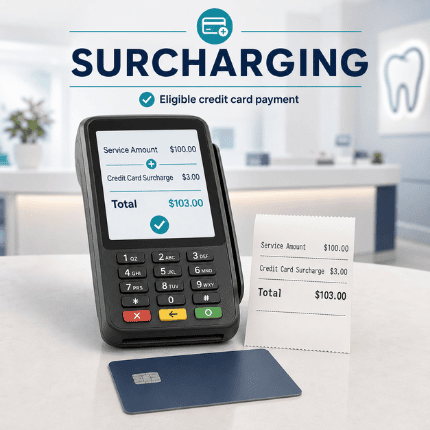
A surcharge is a clearly disclosed fee added when a patient chooses to pay with an eligible credit card. The practice continues to quote or display its standard price, and the surcharge is added at checkout.
For example, if a patient has a $1,000 dental treatment balance and the practice applies a compliant 3% surcharge, the total credit-card payment would be $1,030. A patient who uses an eligible alternative payment method would pay $1,000.
The important word is eligible. A compliant surcharge cannot simply be added to every card transaction. Under PayLow Pro’s program, surcharges apply only to eligible credit cards—not debit cards, prepaid cards, HSA cards, cash or ACH payments. That remains true when a debit card is processed without a PIN or the patient asks to “run it as credit.” PayLow Pro’s technology identifies card types automatically so the surcharge is applied only when permitted.
Surcharging also carries specific compliance requirements. The surcharge cannot exceed the practice’s actual cost of credit-card acceptance or the applicable card-brand limit. Visa currently limits U.S. surcharges to 3%, while Mastercard publishes a 4% maximum; in practice, the lower applicable limit and the practice’s actual acceptance cost control. Card-brand rules require advance notice, clear disclosures before payment and identification of the surcharge on the receipt. State law may impose additional restrictions.
When a refund is issued, the corresponding surcharge must also be refunded proportionally. PayLow Pro assists with enrollment, required notifications, signage, automated calculations and reporting.
Surcharging may be a good fit when your practice:
Collects a significant share of payments through online portals, payment links, invoices or by phone
Wants to preserve its current quoted or advertised prices
Receives a high proportion of payments on eligible credit cards
Has relatively little American Express volume or can exclude card types that are not part of the program
Is comfortable following the additional disclosure and card-brand requirements
The limitation healthcare practices should examine closely
Surcharging can offset much of the expense associated with eligible credit cards, but it does not address the processing cost of debit, prepaid and HSA card transactions. If a large share of patients use those cards, the practice will continue absorbing the related fees.
That distinction matters at the front desk. U.S. Bank’s healthcare payments research found that point-of-service debit is the preferred option for smaller healthcare balances, while credit becomes more prominent for larger balances. A practice collecting many modest copays may therefore recover less through surcharging than a dental practice collecting larger treatment balances on credit cards.
What Is Dual Pricing?
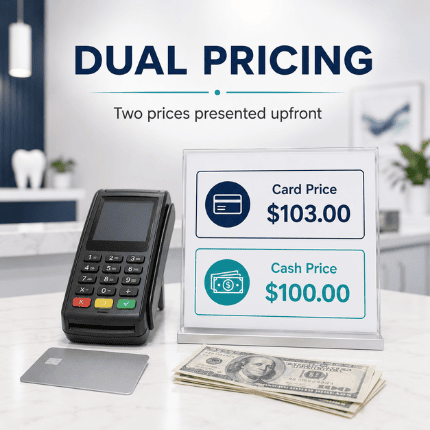
Dual pricing takes a different approach. Instead of adding a fee at checkout, the practice establishes two prices from the beginning:
A regular price for card payments
A discounted price for patients who pay with cash
For example, a procedure might have a regular card price of $1,030 and a discounted cash price of $1,000. The patient sees both options and chooses how to pay. The card price is not the cash price plus a last-minute fee; it is one of two established prices.
PayLow Pro’s dual pricing technology automatically calculates and presents the card and cash prices at the terminal. The displayed or quoted price must meet applicable disclosure requirements; PayLow Pro notes that the card price must be displayed and that some states require both prices to be shown.
Because dual pricing is a pricing model rather than a fee placed on a specific card transaction, it can provide broader cost recovery across the practice’s card mix, including situations in which a patient uses debit or an HSA card. It can also accommodate American Express. This is one reason PayLow Pro generally identifies dual pricing as the better choice for practices seeking maximum cost recovery and straightforward in-office transparency.
Dual pricing may be a good fit when your practice:
Collects most patient balances in person
Accepts a meaningful amount of debit, HSA or American Express payments
Wants to recover more of the cost associated with its overall card volume
Can consistently quote or display the regular card price and discounted cash price
Wants staff to present payment options before the patient reaches the final payment screen
The operational consideration
Dual pricing requires the practice to think differently about how prices are communicated. Fee schedules, treatment estimates, financial policies, websites, appointment reminders and staff scripts may need to reflect the regular card price and cash option accurately.
That does not have to create a difficult patient conversation. In fact, presenting both prices early can make the choice feel more transparent. The strongest approach is simple and neutral: “Your card price is $1,030, or you can receive the discounted $1,000 price when paying with cash.”
For healthcare and dental practices, timing matters. U.S. Bank found that 45% of patients were less than satisfied with the adequacy of information they received about medical bills. Explaining payment options when a treatment plan is accepted, an appointment is scheduled or an estimate is provided is generally better for the patient experience than introducing the difference only at checkout.
Surcharging vs. Dual Pricing at a Glance
| Consideration | Surcharging | Dual pricing |
|---|---|---|
| How it works | Adds a disclosed fee to eligible credit-card transactions | Establishes a regular card price and a discounted cash price |
| Debit, prepaid and HSA cards | Cannot be surcharged | Card price can apply because no surcharge is added |
| American Express | May need to be excluded depending on program and acceptance rules | Can be accommodated |
| Cost-recovery potential | Recovers eligible credit-card costs, but not all card costs | Generally offers broader cost recovery across card types |
| Price presentation | Existing price remains; surcharge is disclosed before payment and on the receipt | Card and cash prices are established and communicated upfront |
| Online/card-not-present payments | Often a strong fit | Available, but requires consistent presentation of both prices |
| Compliance workflow | More card-brand notification, eligibility and disclosure rules | Requires accurate pricing and disclosures under applicable law |
| Often best suited for | Practices with substantial online and eligible credit-card volume | Practices with in-office collections and a varied card mix |
Which Program Is Better for Your Practice?
There is no universal answer, but the following questions usually make the choice clearer.
1. How do your patients pay today?
Review at least three months of transactions by credit, debit, HSA, prepaid, ACH, check and cash. If eligible credit cards dominate, surcharging may recover a meaningful share of your costs. If debit and HSA cards are common, dual pricing may provide broader savings.
2. Where do you collect payments?
A medical group that sends most balances through an online portal may prefer surcharging because it preserves the original bill amount and discloses the surcharge during online checkout. A dental office that presents treatment plans and collects deposits at the front desk may find dual pricing easier to explain upfront.
3. What is your average patient balance?
Patients often use debit for smaller balances and credit for larger expenses. Surcharging may therefore perform differently for a primary-care practice collecting copays than for a dental, orthodontic or specialty practice collecting larger treatment balances.
4. How important is American Express acceptance?
If American Express represents meaningful volume—or is important for patients financing larger elective or dental procedures—dual pricing may be the more flexible option.
5. Which conversation fits your patient experience?
With surcharging, staff explain that an additional amount applies only to eligible credit-card payments. With dual pricing, staff present a regular card price and a discounted cash price. Neither message should be improvised. Clear written policies and short, consistent scripts protect trust and reduce front-desk friction.
The Best Choice Starts With Your Actual Transaction Data
For many healthcare and dental practices, dual pricing offers the greatest cost-recovery potential, particularly when patients frequently use debit cards, HSA cards or American Express and most payments are collected in person. Surcharging can be the better fit when a practice has significant online or card-not-present volume, wants to preserve its existing quoted prices and receives a strong concentration of eligible credit-card payments.
The right answer should be based on your practice’s real payment mix—not a generic recommendation. PayLow Pro can review your processing statement, estimate the potential impact of each program and help you evaluate the compliance, technology and patient-communication requirements before you make a change.
Ready to compare your options? Contact PayLow Pro for a complimentary processing review and find out whether surcharging or dual pricing is the better fit for your practice.